


















On-premise infrastructure has long felt like the “safe” option. Servers are close by, IT teams feel in control, and everything is familiar.
But familiarity can hide risk.
Many server rooms were never designed for the reliability, density and security expectations we now take for granted. As workloads grow and compliance requirements tighten, the gap between what an on-prem environment can realistically provide and what the business expects becomes increasingly obvious.
The Hidden Risk of Staying On-premise
On-prem infrastructure rarely fails dramatically. Instead, it degrades quietly.
Single points of failure creep in. Cooling capacity is stretched. UPS batteries age. Spare parts are hard to source. Maintenance becomes reactive. Backup and disaster recovery are “good enough” until the day they are not.
Scaling also becomes a project in itself. More racks need more power. More power needs more cooling. More cooling needs building work. In many offices, the physical constraints make growth expensive and disruptive.
From a commercial perspective, the true cost of on-prem is often underestimated. Hardware refresh cycles, energy use, facilities overhead, security measures, insurance implications and internal time all add up. Yet these costs are spread across budgets and rarely viewed as a single Total Cost of Ownership.
Why Colocation Changes the Equation
Colocation replaces improvised environments with facilities purpose-built for continuous operation.
Enterprise-grade data centres provide redundant power, resilient cooling, physical security, fire detection and suppression, and 24/7 monitoring. Uptime is engineered. The environment is designed to fail safely, not fail suddenly.
For IT teams, this removes a major operational burden. For business leaders, it reduces uncertainty and operational risk. It also provides a clear foundation for growth: when you need more capacity, you add it without rebuilding your office infrastructure.
Colocation Does Not Mean Giving Up Control
A common concern is loss of control. In practice, Colocation preserves ownership and architectural control while removing facilities management.
You still own the servers. You still choose the platform, the operating systems, the security model and the tooling. What changes is the environment around that infrastructure. Instead of relying on a room that was never meant to be a data centre, you place your equipment in a data centre built for the job.
This is why Colocation is often the most sensible modernisation step for organisations that want to retain control and predictability, without moving everything into public cloud.
Typical Drivers We See
Organisations usually move from on-prem to Colocation for a combination of drivers:
- Resilience: removing single points of failure and improving uptime
- Security: stronger physical security and controlled access
- Compliance: better auditability and operational governance
- Scalability: adding capacity without building work
- Cost control: more predictable running costs and reduced internal overhead
- Focus: allowing IT teams to spend time on services, not facilities
Did you know? For organisations moving from on-premise to Colocation, the infrastructure move is only part of the equation. The real value comes from ensuring systems remain stable, secure and well-managed once they leave the server room. At CWCS, we support on-premise and colocated environments with hands-on technical oversight, from operating system maintenance and security updates through to proactive monitoring and incident response. This gives businesses confidence that relocating infrastructure does not introduce new operational risk, and that responsibility for performance, availability and security is clearly owned and actively managed. We also support Managed Firewall Solutions, including Cisco Duo MFA, for enhanced access control. Explore our services: https://www.cwcs.co.uk/server-management/ and https://www.cwcs.co.uk/cisco-duo-mfa/
The Migration Question: How to do it Safely
The migration is often the point that causes hesitation. Moving live systems carries risk. But that risk can be managed with a structured approach.
A sensible transition typically includes:
- Discovery and assessment of current estate and dependencies
- Design of target environment, power requirements and connectivity
- A staged migration plan with prioritised workloads
- Pre-testing, validation and clear rollback options
- A cutover approach that minimises disruption and protects data integrity
This is where an experienced partner makes a difference. The aim is not to rush. The aim is to move safely, with clarity on roles and responsibilities, and with support available when it matters.
Why This is Happening Now
Energy costs, business continuity expectations and compliance obligations have all increased. At the same time, internal IT teams are being asked to do more with less. In that context, maintaining a private on-prem environment that was never built for modern resilience is a growing liability.
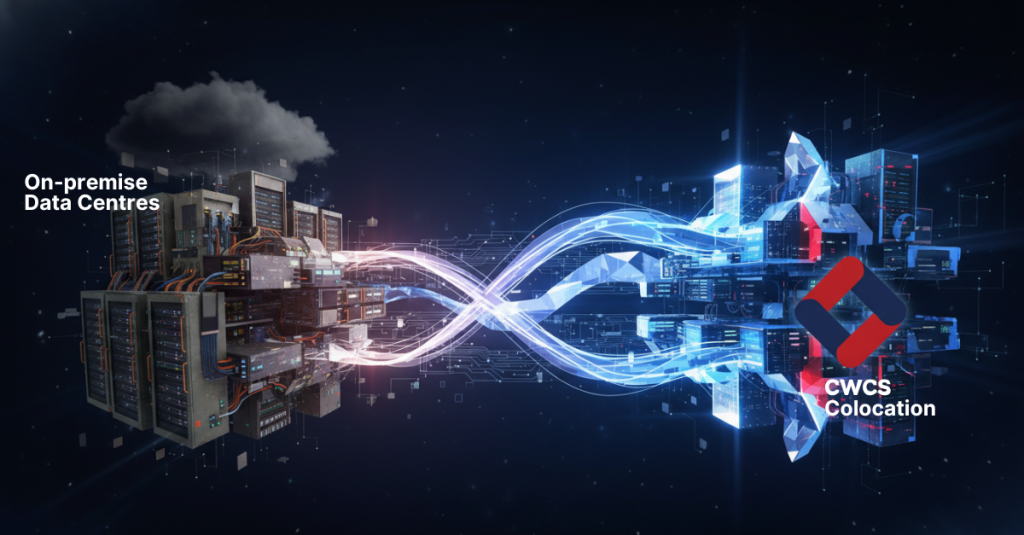
Colocation offers a practical route to modernisation without forcing a full move to public cloud. It can also sit alongside cloud in a hybrid model, where certain systems remain dedicated while others use cloud services. This provides flexibility without surrendering control.
Infrastructure That Supports the Business, Not the Other Way Around
Technology should enable growth, not distract from it.
Moving from on-prem to Colocation stabilises infrastructure, reduces operational risk and creates a scalable foundation that can evolve with the organisation. For many businesses, it is one of the least disruptive yet most impactful infrastructure decisions they make.