


















Why UK Businesses Are Moving with CWCS
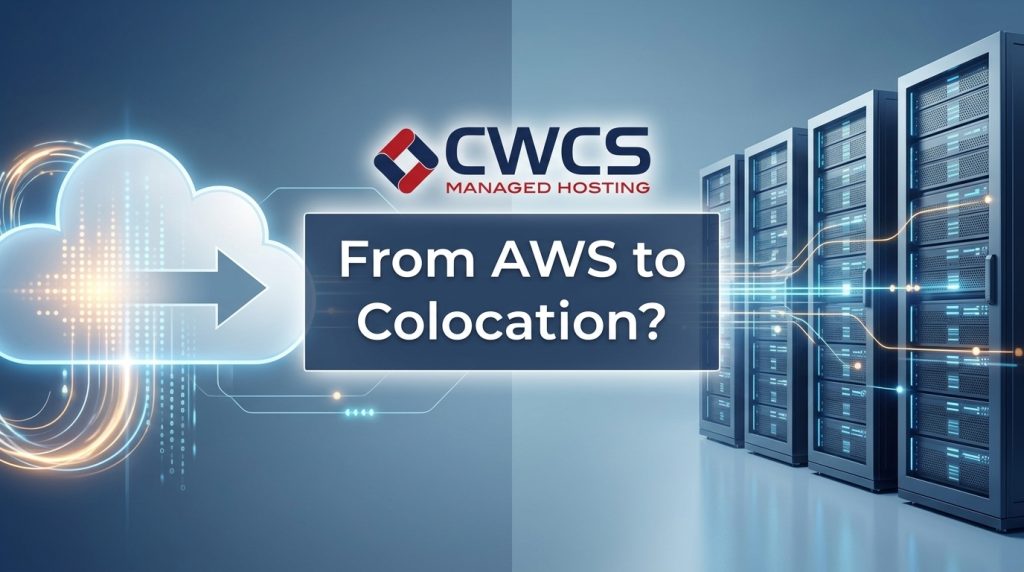
The short answer: AWS works well for burst demand. It is often the wrong model for steady demand. For predictable, compliance‑sensitive, and performance‑critical workloads, UK colocation with CWCS gives lower total cost, clearer control, and more consistent performance.
The Bill Arrived, and It Kept Growing
AWS made sense. Elastic capacity. No hardware cycles. Pay for what you use.
A decade later, many UK teams are seeing the opposite outcome. Costs have risen faster than expected. Forecasting spend is difficult. Teams spend more time managing cost than building systems.
This is not usually down to poor decisions. It is how the model works.
For steady workloads, usage pricing compounds. Small charges stack across services, regions, and data transfers. What looks efficient at small scale becomes expensive at scale.
That is why more teams are moving stable workloads out of hyperscale cloud and into colocation with CWCS, where pricing is fixed and easier to control.
What The Numbers Actually Look Like
Cloud overspend is not unusual. Industry studies regularly show a large share of spend is wasted through overprovisioning and unused capacity.
The structure of billing is the root cause. Compute, storage, and network are all priced separately. Each looks manageable on its own. Together, they are not.
Data transfer is one of the biggest drivers. As systems scale, moving data between services and regions becomes a significant cost that is hard to predict upfront.
For workloads that run continuously, the comparison becomes simple. CWCS colocation replaces variable billing with fixed monthly cost. That removes uncertainty and makes long-term planning easier.
The Regulator Has Already Reached Its Conclusion
UK regulators have already raised concerns about how concentrated the cloud market has become.
For businesses, that matters. Limited competition reduces pricing pressure and makes switching harder.
Colocation with CWCS changes that position. Infrastructure decisions sit with you, not a single vendor. You are not locked into one pricing model or roadmap.
UK Law Has Changed the Compliance Picture
Data sovereignty is now a requirement for many UK organisations.
Public cloud can make this harder to manage. Data may sit in the UK but still be subject to foreign legal access.
With CWCS, infrastructure is physically based in UK Data Centres and governed under UK law. That removes uncertainty and simplifies audits.
Resilience and Risk Have Become Board-level Concerns
Recent outages have shown how dependent many organisations have become on a small number of providers.
The issue is not cloud itself. It is concentration risk.
A hybrid model that includes CWCS colocation reduces that exposure. Critical systems are not tied to a single platform, which lowers the impact of any one failure.
AI is changing the economics further
AI workloads are increasing the pressure on cloud cost models.
GPU-based workloads often run continuously and at scale. Usage-based pricing can become expensive quickly in this scenario.
CWCS colocation provides a more stable cost base for these workloads, especially when demand is consistent.
Not Every Workload Belongs in Colocation
This is not an all-or-nothing decision. It is about placement.
Cloud still works well for short-term or highly variable demand. Colocation is better suited to workloads that run consistently.
Common examples include:
- Databases
- AI training environments
- Healthcare and financial systems
- Backup and disaster recovery
- Core application services
CWCS helps place each workload where it makes the most sense from a cost and performance perspective.
How CWCS Supports AWS to Colocation Migration
Moving away from AWS requires planning, but it does not need to be disruptive.
CWCS supports the process from start to finish:
- Assess workloads and identify what should move
- Specify and deploy the right hardware
- Build the target environment in UK data centres
- Migrate in stages to reduce risk
- Provide ongoing support and monitoring
This keeps the transition controlled and reduces pressure on internal teams.
Why Businesses Choose CWCS
- UK Data Centres in Nottingham, London, and Manchester
- ISO 27001 and ISO 9001 certified environments
- A plus B power for resilience
- 100% renewable energy with REGO certification
- Carrier-neutral connectivity
- 24 7 UK-based support
- Managed and unmanaged options
The result is infrastructure that is predictable, compliant, and supported by engineers who understand the environment.
What to look for in a colocation provider
Focus on the factors that affect long-term outcomes:
- Location and latency
- Level of support
- Network resilience
- Compliance standards
- Pricing clarity
CWCS meets these requirements and supports customers throughout the lifecycle of their infrastructure.
The direction of travel
This is not a move away from cloud entirely. It is a shift towards using the right model for each workload.
UK organisations are becoming more selective. They are balancing cost, control, performance, and risk rather than relying on a single platform.
CWCS supports that shift by providing a stable foundation for workloads that do not benefit from usage-based pricing.
Speak to an expert
If you are reviewing AWS costs or planning a move to colocation, CWCS can help you define the right approach.
Get clear guidance on cost, migration steps, and the right setup for your workloads.