

























Introduction
If you’re setting up a server for your business, one of the first decisions you’ll hit is whether to go managed or unmanaged. It sounds like a small technical detail. It isn’t. A managed server means your Provider handles the setup, security, monitoring and maintenance for you. An unmanaged server hands you full control, and full responsibility, from day one.
The question most guides ask is which one suits your technical skill level. That’s the wrong starting point. The real question is whether you want to build an in-house skill set to run your infrastructure, or pay someone who already has one. Once you look at it that way, the decision gets a lot clearer.
What’s the Difference Between Managed and Unmanaged Servers?
Cloud pricing is usage-based and made up of multiple components, including compute, storage, data transfer, and API. A managed server is one where your Hosting Provider takes care of the technical side of running it. That includes the operating system, security patches, monitoring, backups, and day-to-day support. You get the performance and control of dedicated infrastructure without having to keep it running.
An unmanaged server gives you the hardware and a connection, and leaves the rest to you. Your Provider keeps the physical machine online, but software, security and troubleshooting sit entirely on your side.
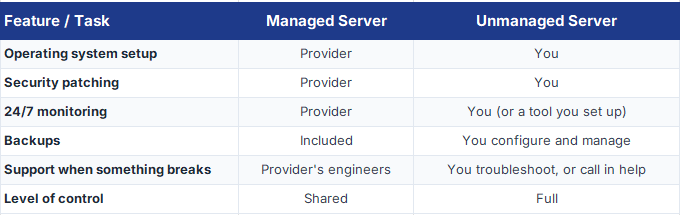
If patching, monitoring and backups aren’t something your team wants to take on directly, CWCS also offers Server Management Services as a standalone add-on, so you can keep control of an unmanaged setup while handing off the day-to-day maintenance.
What You’re Actually Signing Up For
The table above covers the basics, but the practical difference shows up in how each option behaves when something goes wrong. With a managed server, an issue gets picked up by monitoring before you notice it, and an engineer is already on it. With an unmanaged server, you’re the one who finds out something’s wrong, and you’re the one who fixes it.
That’s not a criticism of unmanaged hosting. It’s a genuinely good fit for the right team.
It’s just worth being honest about what you’re taking on. Our own Dedicated Servers page breaks down both options side by side if you want to see how the specifics compare.
The Real Cost Comparison, It’s Not Just the Monthly Price
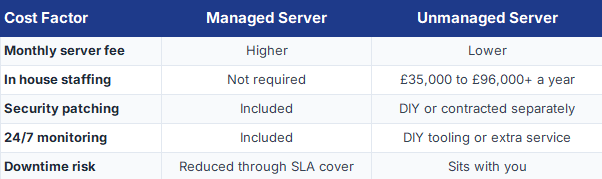
Unmanaged servers usually look cheaper on paper. That’s true if you’re only comparing the monthly fee. It stops being true the moment you factor in who’s going to run the thing.
The average salary for a systems administrator in England sits around £34,795 a year, rising to £45,000 to £48,000 at mid career level (Indeed, IT Jobs Watch, 2026). For a business running a couple of servers with any kind of on call cover, that’s a minimum of £70,000 to £96,000 a year in salary alone, before National Insurance, pension contributions and recruitment costs.
Compare that with the typical gap between managed and unmanaged pricing, usually somewhere between £50 and £150 a month. If your business loses money every hour a server is down, a managed service that costs £150 a month more than unmanaged pays for itself long before the year is out.
Why This Decision Carries More Weight in the UK Right Now
A few things happening in the UK make this less of a nice-to-have conversation and more of a business risk conversation.
The IT skills gap is real.
81% of UK businesses say they’ve been negatively affected by a shortage of skilled IT professionals, and cybersecurity and cloud skills are the hardest roles to fill (Hyve Managed Hosting, IT and Tech Skills Gap Report, 2024). Nearly two-thirds of UK business leaders already work with a managed Provider, and 90% of those do it specifically to close that skills gap.
Downtime is expensive.
UK businesses lost £3.7 billion to internet and connectivity failures in 2023, and the average SME loses roughly £7,500 a year to unplanned downtime (Beaming, 2024). Around 1 in 6 UK businesses start losing money the moment their systems go down, not after an hour, immediately.
Cyber risk is rising fast.
67% of UK SMEs experienced a cyber attack in 2025, up from 50% the year before, and the average breach now costs a UK SME £6,400, a 52% jump in a single year (AMVIA, UK SME Cybersecurity Report, 2026). Patch management and firewall configuration, both standard parts of a managed service, sit right at the centre of preventing that.
Compliance is tightening.
UK GDPR, FCA operational resilience rules and NCSC Cyber Essentials all place real obligations on how infrastructure is run. A managed Provider typically takes on a chunk of that burden directly, rather than leaving you to build the documentation and controls from scratch.
None of this means unmanaged is the wrong choice. It means the choice carries more weight than it used to, and it’s worth making with real numbers in front of you rather than a gut feeling about price.
When Unmanaged Makes Sense
Unmanaged is a genuinely strong option if:
– You’ve already got an in-house DevOps or sysadmin team with the time and tooling to handle patching, monitoring and incident response.
– You’re running development, testing or sandbox environments where downtime is fine, and compliance isn’t a factor.
– Your workload needs deep, custom configuration at the OS or kernel level that a standard managed setup wouldn’t easily support.
– Cost is the main driver, and you already have the in-house expertise to make unmanaged genuinely cheaper, not just cheaper on the invoice.
When Managed Makes Sense
– You don’t have a qualified sysadmin on staff, and running unmanaged infrastructure without one is a real risk, not a manageable gap.
– Your business isn’t IT. Sales, retail, healthcare and professional services teams generally shouldn’t be spending leadership time on server administration.
– You’re subject to compliance obligations like UK GDPR, FCA rules or sector-specific frameworks.
– Uptime is commercially critical. Ecommerce, SaaS and client-facing platforms can’t absorb unpredictable outages.
– You’d rather have a predictable monthly cost than an unpredictable staffing and risk bill.
A Five Question Self Assessment
If you’re still weighing it up, these five questions cut through most of the noise:
1. Do we have at least one qualified in house sysadmin? If no, managed.
2. Do we face regulatory or compliance obligations? If yes, managed.
3. Would a four hour outage cost us more than managed hosting costs per month? If yes, managed.
4. Have we had a cyber incident in the last two years? If yes, managed.
5. Is our IT team already stretched across other priorities? If yes, managed.
If most of your answers land on managed, that’s your answer. If they don’t, unmanaged is likely the right call for where your business is today.
How CWCS Approaches Managed Hosting
CWCS has been running UK infrastructure since 1999, and managed hosting is built around one idea: you shouldn’t need to hire a server admin to have reliable, secure infrastructure.
That includes a financially backed 100% Network Uptime Guarantee, ISO 27001 and ISO 9001 certified operations, and UK-based engineers who are on hand 24/7. Faulty hardware is replaced within an hour under our dedicated server SLA. Everything runs through what we call the CWCS Managed Infrastructure Layer, the layer of monitoring, patching and support that sits on top of your server so you’re not the one keeping it running.
You can see the full specification for Managed Dedicated Servers or Managed Cloud Hosting, depending on which infrastructure shape fits your business.
FAQs
Is Managed Hosting worth the extra cost?
For most UK SMEs without an in-house sysadmin, yes. The monthly price gap is usually £50 to £150, while the cost of hiring even part-time technical staff to do the same job runs into tens of thousands a year. Add in the downtime and compliance risk of getting it wrong, and managed hosting is often the cheaper option once you look at the full picture.
Can I move from unmanaged to managed later?
Yes, and it’s a common path. Many businesses start unmanaged while budgets are tight, then move to managed as the infrastructure becomes more business-critical. CWCS offers a free migration service, so switching over doesn’t add cost on top of the decision to move to managed.
What happens if an unmanaged server gets breached?
With unmanaged hosting, incident response sits with you or whoever you’ve contracted to handle it. Your Provider keeps the physical hardware and network running, but investigating and resolving a breach on the server itself is your responsibility, which is why patch management and monitoring matter so much if you’re going unmanaged.
Do I lose control with managed hosting?
You lose some low-level access, but not meaningful control over your business outcomes. Most managed Providers, CWCS included, still give you access to your applications and data. What changes is who’s responsible for the underlying server, not what you’re able to do with it.
Which One’s Right for You?
If you’ve got the in-house skills and the time to use them, unmanaged gives you full control at a lower headline price. If you don’t, or if downtime, compliance or security risk would hit your business hard, managed hosting is very likely the safer and, once you factor in staffing costs, the cheaper choice.
Run through the five questions above, be honest about where your business actually sits today, and the right answer tends to be obvious.
Find the Right Service for Your Workloads
If you are reviewing your current setup, assessing workload requirements and cost structure can help determine whether Cloud, Colocation, or a hybrid approach is more suitable.
Speak to our team to explore infrastructure options based on your specific requirements. You can also review Colocation Services, Dedicated Servers, or Cloud Hosting.