















For most organisations, running a Data Centre is not their core business.
You might be a law firm, retailer, manufacturer or SaaS provider. Your competitive edge comes from products, customers and innovation, not from specifying UPS systems, modelling cooling, or recruiting 24/7 facilities engineers.
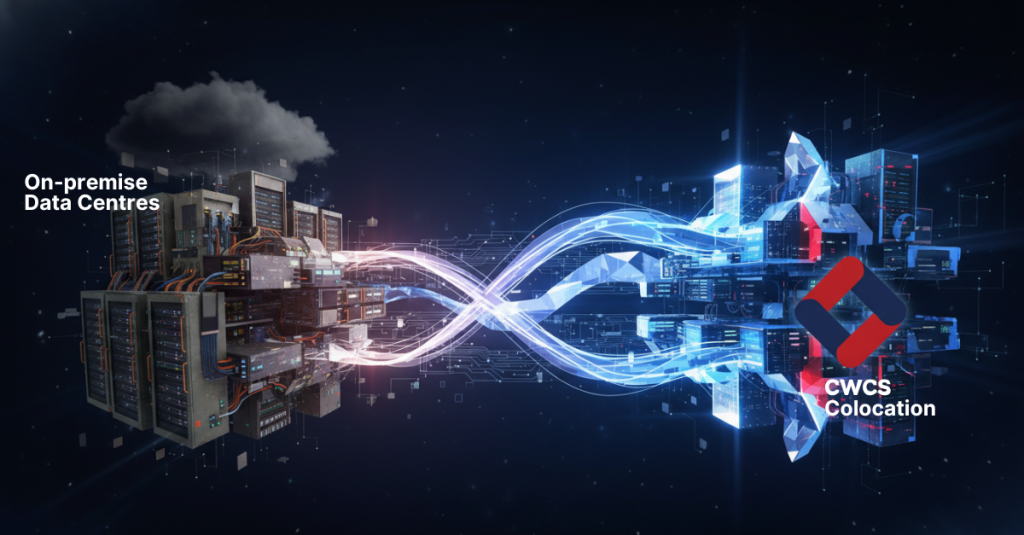
That is why more workloads are moving out of on-premise rooms and ageing enterprise Data Centres into specialist colocation facilities and private cloud platforms.
Independent analysis from Lawrence Berkeley National Laboratory, summarised by Brightlio, estimates that around 75 percent of servers were already installed in hyperscale or colocation facilities in 2023, and that internal enterprise Data Centres will fall to less than 2 percent of total server energy use by 2028. In parallel, colocation and modular campuses are scaling quickly. Market commentary consistently notes that the majority of new capacity growth is being delivered through shared colocation environments rather than owner-occupied enterprise builds.
So what is driving that move, and why can colocation be a better option than building or expanding an in-house facility?
In this article, we look at cost, risk and focus, and explain how CWCS colocation, backed by 24/7 onsite staff and ownership of its Nottingham Data Centre, fits alongside cloud and dedicated servers in a modern hybrid strategy.
Cost: Avoiding Data Centre capex and hidden total cost of ownership
Building or upgrading a Data Centre is capital intensive.
Savills’ latest UK and EMEA research places current Data Centre build costs in the range of £6m to £11m per megawatt of commissioned IT load, depending on location, resilience tier and power density. This includes land, structure, electrical and mechanical systems, cooling, fire safety and fit-out, before design fees, contingency and future expansion.
At the same time, research into Data Centre total cost of ownership shows that capital expenditure typically represents 60–70 percent of initial project cost, with operational expenditure such as power, staffing, maintenance, compliance and insurance becoming the dominant cost over time.
In practice, owning a facility exposes organisations to two compounding pressures:
- Significant upfront capital investment to design and build the site
- Long-term operational costs that are difficult to optimise at single-site scale
Colocation changes that equation. Instead of funding and maintaining the building, power and cooling infrastructure yourself, you pay a predictable recurring fee for space, power and services within a professionally operated facility that has already absorbed those upfront costs.
In addition, Colocation removes the need to overbuild for future growth. Organisations no longer have to invest upfront in excess space, power or cooling “just in case”. Capacity can be added incrementally as demand increases, aligning infrastructure spend directly with business growth.
A UK-based illustrative comparison (GBP)
Every environment is different, but a UK-focused example helps frame the decision.
Industry analysis from UK property and infrastructure advisors suggests that a 50–200kW enterprise Data Centre environment typically incurs:
On-premise (UK, indicative):
• Build and fit-out costs often exceeding £400,000–£1.5m depending on resilience, power and space
• Ongoing costs for power, cooling, maintenance contracts, compliance testing and insurance
• Staffing or on-call cover to support incidents outside office hours
• Exposure to energy price volatility and equipment refresh cycles
By contrast, a comparable colocation deployment in the UK converts those variables into:
• A known monthly operating cost covering space, power and facilities management
• Shared access to resilient power, cooling and security infrastructure
• 24/7 onsite engineering without maintaining your own facilities rota
• The ability to scale up or down without rebuilding physical infrastructure
If additional capacity is required – for example an extra rack, higher power density or expanded footprint, this can typically be delivered far faster within a Colocation facility than through building or extending an in-house Data Centre, where planning, construction and fit-out can take many months or even years.
For many organisations operating modest-scale environments, particularly those running legacy server rooms, the avoided capital spend, reduced operational risk and improved uptime often outweigh the recurring colocation fee over a three- to five-year horizon.
The precise numbers will vary by location and design, but the strategic benefit is consistent: colocation replaces large, irreversible capital decisions with flexibility and cost transparency.
Where the money is really going: power, labour and compliance
Whether you own the facility or colocate, you still have to power the IT.
UK and global surveys consistently show that power is now the fastest-growing unit cost, followed closely by labour and compliance. Energy prices, sustainability requirements and skills shortages continue to push operating costs higher.
A Colocation Provider can absorb and optimise those pressures across multiple customers, investing in efficiency improvements at scale. An individual enterprise Data Centre generally cannot.
When you Colocate, you still own and refresh your hardware, but you avoid:
• Hiring and retaining 24/7 facilities specialists
• Managing multiple vendor contracts
• Carrying sole responsibility for plant failure or compliance breaches
Focus and risk: running Data Centres is not your core business
Multiple independent sources point to the same conclusion. Enterprises are reassessing whether they want to remain in the facilities business at all.
At the same time, many organisations are selectively moving predictable workloads out of public cloud to regain cost control, while avoiding the capital burden of on-premise infrastructure.
The common thread is focus.
If you are an enterprise, your core competence is applications, data and customer experience.
If you are a colocation provider, your core competence is designing, building and operating resilient, energy-efficient infrastructure.
Outsourcing the concrete, copper and cooling allows internal teams to focus on higher-value work.
It also provides the operational agility to respond to growth, seasonal demand or changing technology requirements without being constrained by fixed, self-built facilities.
Why CWCS Colocation in particular
Choosing Colocation is only half the decision. The other half is choosing a partner whose infrastructure strategy aligns with long-term risk management.
A critical and often overlooked factor is who owns the Data Centre itself.
CWCS owns and operates its Nottingham Data Centre outright. We do not rely on leased or wholesale facilities.
This matters.
Across the UK, many providers operate from leased buildings that can be repurposed, sold or constrained as land values rise. That creates uncertainty for customers running long-lived, mission-critical platforms.
Ownership gives CWCS full control over:
• Long-term investment in power, cooling and resilience
• Sustainability improvements and efficiency upgrades
• Capacity planning without lease constraints
• The future of the facility itself
This ownership model also enables CWCS to plan and deliver scalable growth for customers over the long term, ensuring additional space and power can be brought online in line with evolving business requirements.
For customers, this means confidence that their infrastructure is housed in a site designed to support them for the long term.
Colocation plus Cloud and Dedicated Servers
Colocation is not an island.
CWCS also operates Managed Cloud and Dedicated Server platforms from the same Data Centres, allowing organisations to combine:
• Colocation for owned hardware and licensing-sensitive workloads
• Cloud for elastic demand
• Dedicated servers for performance-critical systems
Keeping these environments within the same facilities and network fabric reduces latency, complexity and supplier sprawl.
This integrated approach further supports scalability, allowing infrastructure to grow across physical and virtual platforms as businesses and organisations needs evolve.
A Pragmatic Hybrid Path
The aim is not to claim Colocation is always cheaper.
However, rising energy costs, capital intensity, sustainability pressure and operational risk are pushing more organisations towards hybrid models.
A pragmatic path often includes:
- Retiring inefficient on-premise rooms
- Moving steady workloads into colocation
- Using cloud selectively
- Reassessing as requirements evolve
Final thought
When boards demand both cost discipline and resilience, running an in-house Data Centre is increasingly difficult to justify unless it is strategic at scale.
Colocation with a specialist, owner-operator like CWCS allows organisations to reduce facilities risk, improve resilience and sustainability, and keep teams focused on what truly differentiates the business.
Just as importantly, it provides a scalable platform that can grow in line with the organisation, adding capacity quickly and efficiently without major capital projects.
If you would like to explore what this could look like for your organisation, including a UK-specific cost and risk comparison based on your actual requirements, the CWCS team would be happy to help.